Elon Musk Testifies in OpenAI Lawsuit, Warns Jury About Charity Looting
Key Points
- Elon Musk testified that his $44 million donation to OpenAI was intended for a nonprofit AI safety project.
- Musk seeks up to $134 billion in damages for the nonprofit, removal of Sam Altman and Greg Brockman, and a court order to revert OpenAI to nonprofit status.
- OpenAI argues Musk originally supported a for‑profit conversion and is now using the lawsuit to harm a competitor.
- An email from former board member Shivon Zilis shows Musk discussed profit‑conversion options, a key piece of evidence for both sides.
- Judge Yvonne Gonzalez Rogers will likely follow the jury’s liability recommendation but decides on any structural remedy.
- A ruling against OpenAI could disrupt a $110 billion funding round and threaten the company’s planned IPO.
- Testimony from key figures, including Sam Altman, Satya Nadella and Ilya Sutskever, is scheduled in the coming weeks.
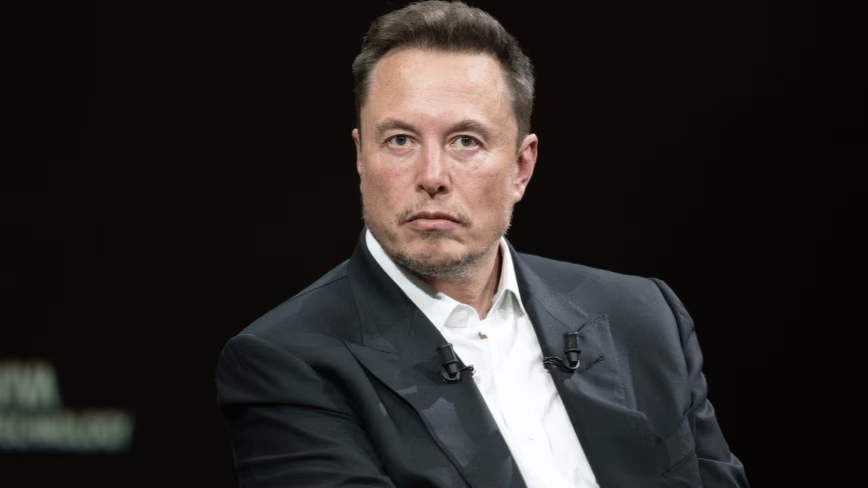
Elon Musk took the stand Tuesday in a federal courtroom in Oakland, framing his lawsuit against OpenAI as a defense of charitable trust rather than a personal profit dispute. The billionaire claims the nonprofit he funded with $44 million was betrayed when OpenAI’s leaders turned the organization into a for‑profit entity, a move he says threatens the foundation of charitable giving in the United States. Musk seeks up to $134 billion in damages for the nonprofit, the removal of CEO Sam Altman and President Greg Brockman, and a court order to revert OpenAI to nonprofit status. OpenAI’s lawyers argue Musk originally supported a for‑profit conversion and is now using the courts to damage a competitor.
Elon Musk became the first witness for the plaintiff in the high‑stakes trial over OpenAI’s 2025 shift from a nonprofit to a for‑profit model. Speaking before a jury in Oakland, California, Musk warned that allowing a charitable organization to be “looted” would erode public confidence in America’s entire charitable sector. He said the case is simple: the $44 million he donated was meant to fund a nonprofit AI safety project, and the subsequent conversion violated that trust.
While on the stand, Musk emphasized that any monetary award would be directed to OpenAI’s nonprofit foundation, not to him personally. He asked the jury to order up to $134 billion in restitution, the removal of Sam Altman from the board and his role as chief executive, the ouster of President Greg Brockman, and a court‑mandated reversion to nonprofit status. The plaintiff’s legal team presented the argument that Musk’s donation created a charitable trust obligating OpenAI to remain tax‑exempt.
OpenAI’s defense, led by attorney William Savitt, painted a contrasting picture. According to the company, Musk supported a for‑profit restructuring as long as he retained control. The defense introduced an email from former board member Shivon Zilis that described two profit‑conversion options discussed with Musk, suggesting he never insisted the organization remain purely nonprofit. Savitt told the jury that Musk used his funding promises to pressure the founders and later left the company when his bid for control failed.
The divergent narratives hinge on whether Musk’s donation was a conditional gift tied to nonprofit status or an unconditional contribution to an AI venture. The email evidence could swing the jury’s view: if it shows Musk backing a for‑profit plan, his claim of a charitable breach weakens; if it reveals he demanded personal control, it supports the plaintiff’s position but also shows Musk was involved in restructuring talks.
Judge Yvonne Gonzalez Rogers presiding over the case has indicated she will likely follow the advisory jury’s verdict on liability, though she retains sole authority over any structural remedy. The stakes extend beyond the courtroom. OpenAI’s recent $110 billion funding round, which valued the company at $852 billion, relied on the for‑profit structure remaining intact. A verdict forcing the company to unwind the conversion could jeopardize investments from Microsoft, Amazon, SoftBank, Nvidia and others, potentially delaying the anticipated IPO.
Both sides are set for extensive testimony. Musk’s appearance is expected to last more than two hours, while OpenAI’s leadership, including CEO Sam Altman and former CTO Mira Murati (via deposition), will also testify. Microsoft CEO Satya Nadella and co‑founder Ilya Sutskever are slated to provide additional perspectives.
The outcome will shape not only the future of the world’s most valuable AI startup but also set a legal precedent for how charitable contributions intersect with corporate restructuring. As the trial proceeds, industry observers watch closely, noting that the decision could reverberate through the broader tech and investment communities.