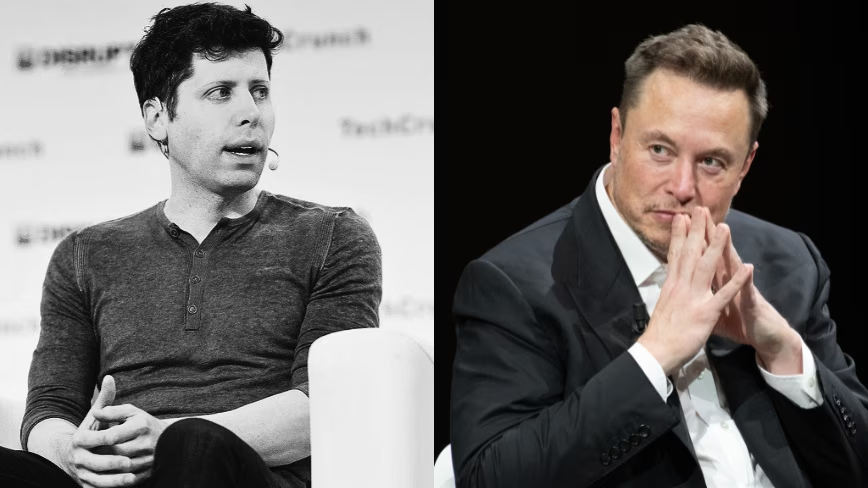
Elon Musk and Sam Altman face off in Oakland as OpenAI trial begins
Key Points
- Jury selection started Monday for a four‑week trial in Oakland, California.
- Elon Musk alleges OpenAI breached its nonprofit charter when it converted to a for‑profit entity in 2019.
- Musk seeks $150 billion in damages for OpenAI's charitable arm and the removal of Sam Altman from leadership roles.
- OpenAI counters that Musk was aware of the transition and left voluntarily after a failed merger proposal with Tesla.
- Key evidence includes a 2017 diary entry by co‑founder Greg Brockman questioning Musk's leadership ambitions.
- Witnesses will include Musk, Altman, Microsoft CEO Satya Nadella and former board member Shivon Zilis.
- Judge Yvonne Gonzalez Rogers barred questions about Musk’s alleged ketamine use but allowed other lines of inquiry.
- A ruling forcing OpenAI back to nonprofit status could derail its planned IPO and affect Microsoft’s stake.
- The trial underscores the personal and corporate stakes in the rapidly evolving AI industry.
Jury selection started Monday in the U.S. District Court for the Northern District of California, marking the opening of a four‑week trial that pits Elon Musk against OpenAI CEO Sam Altman. Musk alleges the nonprofit he helped launch was fraudulently converted into a for‑profit entity, seeking $150 billion in damages and the removal of Altman. OpenAI counters that Musk was aware of the transition and left the board voluntarily. The case, overseen by Judge Yvonne Gonzalez Rogers, could reshape the company’s future and its planned IPO.
Oakland, Calif. – Jury selection began Monday in a federal courtroom that will host a high‑stakes showdown between Tesla and SpaceX founder Elon Musk and OpenAI chief Sam Altman. The trial, set to run four weeks through mid‑May, will examine Musk’s claim that the artificial‑intelligence lab he co‑founded in 2015 was unlawfully turned into a for‑profit venture.
Judge Yvonne Gonzalez Rogers presides over the case and has accelerated the core claims, citing a significant public interest in a swift resolution. Musk’s lawsuit, filed in August 2024, accuses Altman, co‑founder Greg Brockman and Microsoft of breaching charitable trust, committing fraud and aiding the alleged breach. He asks a court‑ordered $150 billion in damages, to be funneled to OpenAI’s charitable arm, and seeks Altman’s removal from both the for‑profit and nonprofit boards, along with an order to revert the organization to nonprofit status.
OpenAI’s defense argues that Musk never was deceived about the 2019 conversion. Internal documents show he participated in discussions about the shift, but wanted the company merged with Tesla and to lead the combined entity. When Altman and Brockman rejected that plan, Musk left and later launched his own AI lab. A diary entry by Brockman from autumn 2017, which reads, “This is the only chance we have to get out from Elon. Is he the ‘glorious leader’ that I would pick?” will be a focal point for both sides. Musk will point to the note as evidence of a conspiracy to sideline him; OpenAI will cite it as proof that leadership had legitimate concerns about Musk’s ambitions.
The witness list reads like a who’s‑who of the AI era. Both Musk and Altman are expected to testify in person, as is Microsoft CEO Satya Nadella. Former OpenAI board member Shivon Zilis, also the mother of four of Musk’s children, will appear, and OpenAI’s lawyers plan to argue that she passed internal information to Musk after he left the board.
Pre‑trial rulings have already narrowed Musk’s claims. He initially sought personal damages exceeding $100 billion, but the court trimmed the request, redirecting the entire $150 billion to the nonprofit arm. The judge also barred questions about Musk’s alleged ketamine use, though inquiries into his attendance at the 2017 Burning Man festival and his relationship with Zilis remain permissible.
The outcome carries existential implications for OpenAI. A ruling that forces the company back into nonprofit status would jeopardize its ability to raise capital, threaten a planned IPO that could value the firm at up to $1 trillion, and undermine Microsoft’s 27 percent stake in the public‑benefit corporation. OpenAI currently serves nearly one billion weekly active users and recently closed a $122 billion funding round.
Beyond the legal battle, the trial spotlights the broader clash of personalities that has defined the AI era. Musk’s public offers to buy OpenAI—first $97.4 billion in early 2025, then a counter‑offer from Altman to purchase X for $9.74 billion—have kept the feud in the headlines. As the courtroom drama unfolds, the tech world watches to see whether the case will reshape the governance of one of the most influential AI platforms and set precedents for future AI newsroom and news automation ventures.