Promotions, Not Perks, Drive Early Tech Employee Turnover, Study Finds
Key Points
- Study surveyed 205 tech professionals and built a machine‑learning model to predict early attrition.
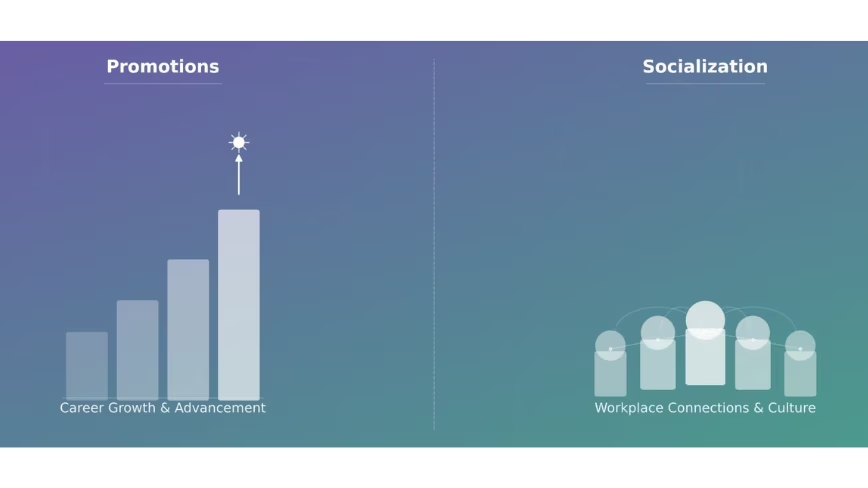
- Promotions were the strongest predictor; fewer promotions dramatically increased turnover risk.
- Younger employees, lack of internal role changes, and stable manager assignments also correlated with early exits.
- Socializing outside work showed near‑zero impact on whether employees left within a year.
- Model achieved a 0.97 F1 score using Extra Trees Classifier and SMOTE for class imbalance.
- Replacing a tech employee can cost up to 2.5 times their salary, affecting profit margins.
- All predictive factors exist in typical HRIS data, enabling early identification of at‑risk staff.
- Proactive career‑momentum interventions in the first six months can reduce early attrition.
A People Analytics study of 205 tech professionals used a machine‑learning model to predict early attrition and found that promotions are the single strongest predictor of whether employees leave within their first year. Age, internal role changes and manager changes also mattered, while socializing outside work had little impact. The model achieved a 0.97 F1 score, underscoring that career momentum, not workplace culture, drives turnover. The research suggests firms can spot at‑risk staff using existing HR data and intervene far earlier than traditional retention programs allow.
A People Analytics survey of 205 technology professionals revealed that early employee attrition in the sector is driven more by stalled career momentum than by cultural factors. Researchers asked participants about their current and previous tech roles, then trained a machine‑learning model to predict whether a worker would leave a job within the first twelve months.
The model, which combined an Extra Trees Classifier with SMOTE to address class imbalance, achieved an F1 score of 0.97. That performance indicates the algorithm reliably identified the high‑risk pattern despite the small sample size.
Promotion history emerged as the loudest signal. The number of promotions a worker received in their previous job had a correlation of –0.54 with early attrition, meaning fewer promotions dramatically increased the likelihood of leaving. Almost half of the respondents (49 percent) had never been promoted in their prior role, highlighting a widespread gap in career advancement signals.
Age also proved significant. Younger employees were markedly more likely to depart early, with a –0.49 correlation between age and attrition. The finding aligns with the intuition that early‑career staff have lower sunk costs and higher expectations for rapid progression.
Contrary to common assumptions, internal mobility and manager changes reduced the risk of early turnover. Employees who had switched roles or teams within their previous company were less likely to leave within a year (correlation –0.49), and those who experienced multiple manager changes showed a similar protective effect (correlation –0.44). The researchers note that tenure length can bias these metrics—workers who stay longer simply have more opportunity to accrue role or manager changes—but the directional signal remained consistent.
The study also debunked the hypothesis that socializing with teammates outside work predicts retention. Socialization frequency displayed a near‑zero correlation with early attrition, suggesting that team‑building activities are at best a trailing indicator of satisfaction, not a leading driver of staying decisions.
Financial stakes are high. Replacing an employee can cost up to 2.5 times their salary when recruiting, onboarding, and lost productivity are factored in. Industry research links a one‑standard‑deviation rise in attrition rates to an 8.9 percent drop in profits, a sobering figure for tech firms already tightening budgets around AI infrastructure and other cost centers.
All of the predictive variables—promotion history, age, internal role changes, manager changes—are already captured in most HR information systems. The study argues that companies are sitting on usable signals without actively reading them. Simple cohort analyses can surface employees who fit the high‑risk profile: younger staff, eight‑plus months in a role, no documented promotion discussion, and no internal moves.
Rather than reacting after an employee hands in a resignation, the researchers recommend treating the first six months of tenure as a risk period that warrants structured, proactive attention. Early‑career hires should receive clear career pathing, timely promotion conversations, and opportunities for internal mobility. When such career‑momentum levers are in place, the data suggests the likelihood of early departure drops substantially.
In an environment where tech companies are simultaneously investing heavily in artificial intelligence and scrutinizing every line of the budget, the cost of preventable attrition becomes an operational priority, not just a soft HR metric. The study’s findings offer a roadmap for firms to shift from culture‑centric retention programs to data‑driven career‑development strategies that address the root cause of early turnover.