Physical AI Moves Beyond Screens: How Machines Perceive, Decide, and Act
Key Points
- Physical AI embeds intelligence in hardware that can sense, decide, and act in real time.
- Key technologies include computer vision, machine learning, reinforcement learning, and agentic reasoning.
- Current deployments span autonomous vehicles, warehouse robots, surgical assistants, and smart‑city simulations.
- Training physical AI requires costly real‑world data; simulations help but cannot fully replace reality.
- Safety and reliability are critical, with edge‑case handling remaining a major challenge.
- Future focus is on embodied AI for elder care, disaster response, agriculture, and broader automation.
Physical AI embeds artificial intelligence in machines that can sense their surroundings, make real‑time decisions, and act in the physical world. From autonomous vehicles and warehouse robots to surgical assistants and smart‑city systems, these technologies blend sensors, computer vision, machine learning, and reinforcement learning to close the perception‑decision‑action loop. While early deployments already exist, challenges around safety, reliability, edge‑case handling, and costly real‑world training remain central as the field pushes toward broader, embodied AI applications.
What Physical AI Is
Physical AI refers to artificial‑intelligence systems that are embedded in hardware capable of perceiving, reasoning, and acting in three‑dimensional environments. Unlike chatbots that operate on text or images alone, physical AI systems gather data from cameras, lidar, microphones, and environmental sensors such as temperature or vibration. They process this stream of information in real time and translate decisions into movements of motors, wheels, robotic arms, or other actuators.
How the Perception‑Decision‑Action Loop Works
These systems operate in a continuous loop. First, sensors capture raw data, which is often noisy and complex—imagine distinguishing a child’s backpack from a mailbox during a rainstorm. Computer‑vision models interpret visual input, machine‑learning models recognize patterns, and reinforcement‑learning components learn optimal actions through trial and error. Some newer platforms also employ agentic reasoning to plan multiple steps ahead.
Once a coherent picture of the environment is formed, the AI makes split‑second decisions—such as whether a drifting plastic bag is harmless or requires the vehicle to slow down. The decision is then executed by sending commands to hardware, resulting in actions like steering, gripping, or navigating.
Current Real‑World Examples
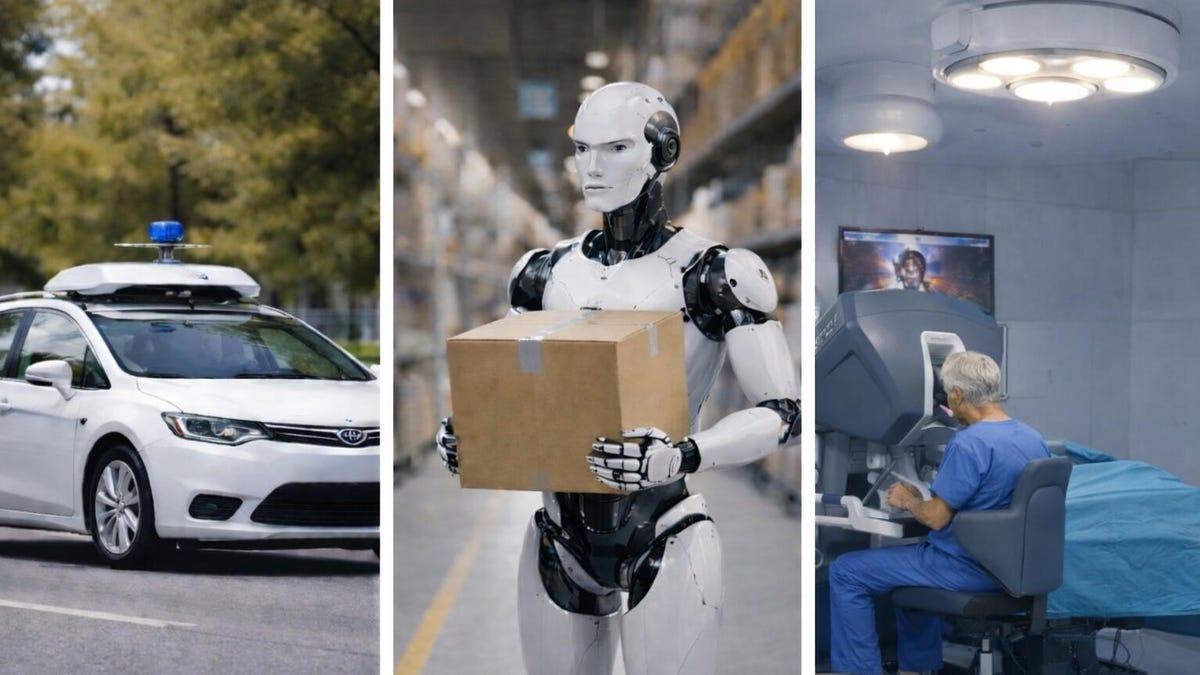
Physical AI is already in use across several domains. Autonomous vehicles such as Waymo robotaxis and Tesla’s self‑driving cars use AI to interpret sensor data and control motion. Industrial robots, including Amazon’s warehouse bots and Tesla’s Optimus humanoid, rely on AI for picking, sorting, and moving packages. Surgical systems like the Da Vinci robot assist doctors with precise movements, while household devices such as Roomba vacuums employ visual simultaneous localization and mapping to navigate homes.
Smart‑city initiatives also leverage physical AI. Singapore utilizes a digital twin—a 1:1 virtual replica of the city—to simulate and optimize urban operations. Projects like Toyota’s Woven City envision AI‑driven infrastructure managing transportation and services.
Differences From Generative AI
Generative AI models like ChatGPT predict patterns in static text or image datasets, which can be trained at relatively low cost. Physical AI must predict outcomes in dynamic, real‑world settings, requiring expensive data collection through actual driving, manipulation, or interaction. To mitigate costs, developers use digital‑twin simulations and synthetic data to train models in virtual environments, though these simulations cannot capture every nuance of real‑world physics.
Safety, Reliability, and Edge Cases
When AI moves from the screen to the world, reliability becomes paramount. Sensors can fail, cameras can be blinded, and human behavior can be unpredictable. Most systems handle common scenarios well but struggle with rare edge cases—such as an overturned truck or a deer darting onto a road. A single misjudgment can lead to real‑world harm, and unlike software bugs, mechanical errors cannot be undone with a simple update.
Current reliability estimates suggest systems may achieve around 99% accuracy, meaning one failure in a hundred could still cause significant damage. Industry experts note that layered safety protections are still evolving, and standards for “safe enough” deployment remain under development.
Future Directions
The next wave of research focuses on embodied AI, where machines learn by interacting with the world rather than just consuming data. Potential applications include elder‑care robots, disaster‑response machines, and autonomous agricultural monitors. As automation expands in warehouses and transportation, physical AI is expected to appear wherever tasks are repetitive and environments are moderately structured.
Overall, physical AI has transitioned from a concept to limited real‑world deployments. Its continued growth will depend on advances in perception, decision‑making, simulation fidelity, and robust safety frameworks.