OpenAI launches Images 2.0, a reasoning‑enabled AI image model with near‑perfect text rendering
Key Points
- Images 2.0 can generate up to eight coherent images from a single prompt.
- Model claims 99% accuracy in rendering text across multiple languages and scripts.
- Took the top spot on Image Arena leaderboard within 12 hours, leading by 242 points over Google’s Nano Banana 2.
- Free‑tier users get "Instant" mode; paid tiers unlock "Thinking" mode with web search and batch generation.
- Pricing ranges from $0.04 to $0.35 per image, with token costs of $8 per million for input.
- API identifier gpt-image-2 will be available to developers in early May 2026.
- Safety features include content filtering and C2PA metadata for provenance.
- DALL‑E 2 and DALL‑E 3 will be retired on May 12, 2026, making Images 2.0 OpenAI’s primary image model.
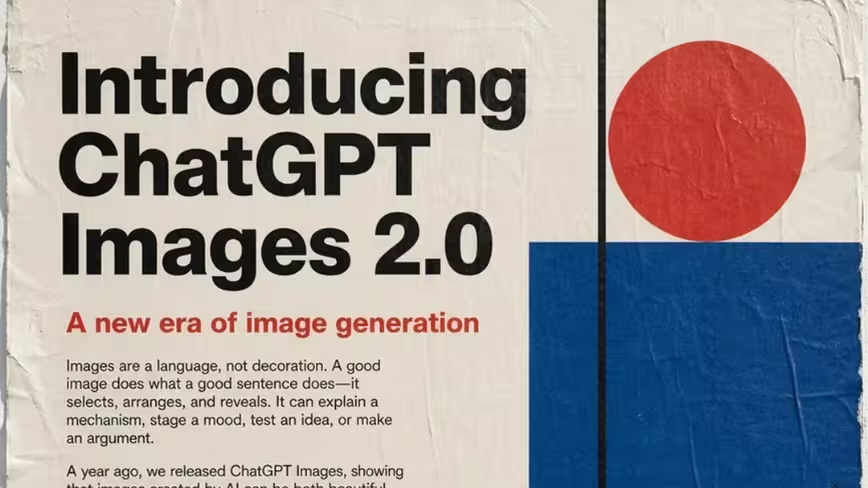
OpenAI unveiled Images 2.0, its latest AI image generator that can reason about composition, search the web for context, and produce up to eight coherent images from a single prompt. The model claims 99% accuracy in rendering text across multiple scripts and surged to the top of the Image Arena leaderboard within 12 hours, outpacing Google’s Nano Banana 2 by a record margin. Free‑tier ChatGPT users receive a basic version, while paid subscribers unlock the full "thinking" mode that includes web‑search and batch generation. Pricing starts at $0.04 per image, with higher‑resolution outputs up to 2K.
OpenAI rolled out Images 2.0 on Tuesday, positioning the new system as a "visual thought partner" that goes beyond pixel‑by‑pixel rendering. The model first scans a prompt, plans composition, reasons about spatial relationships, and can pull real‑time data from the web before drawing. The result: up to eight images that share consistent characters and settings, all generated from a single instruction.
Text rendering, a long‑standing weak spot for AI image tools, reaches roughly 99% accuracy across languages and scripts, including Japanese, Korean, Chinese, Hindi and Bengali. If independent tests confirm the claim, designers could finally rely on the model for production‑grade graphics rather than novelty demos.
Within 12 hours of launch, Images 2.0 claimed the number‑one spot on the Image Arena leaderboard, posting a score of 1,512—242 points ahead of the runner‑up, Google’s Nano Banana 2. The lead marks the largest margin ever recorded on the benchmark, underscoring the model’s immediate impact on the competitive landscape.
OpenAI split the offering into two access modes. "Instant" mode ships to every ChatGPT user, free or paid, delivering the core visual upgrades: sharper layouts, better text, and richer detail. "Thinking" mode, reserved for Plus ($20/month), Pro ($200/month), Business and Enterprise plans, unlocks web‑search, multi‑image batching, and output verification. The premium tier therefore carries the bulk of the reasoning capability that fuels the quality jump.
Pricing follows a token‑based structure. Input tokens cost $8 per million, cached inputs $2 per million, and image output $30 per million tokens. In practice, a single image runs between $0.04 and $0.35 depending on prompt complexity and resolution, which can reach up to 2K.
The model’s API identifier is gpt-image-2, with developer access slated for early May 2026. OpenAI noted a knowledge cutoff of December 2025; anything that emerged after that date requires the model’s web‑search function to stay current.
Safety measures include content filtering, C2PA metadata for provenance, and ongoing monitoring, reflecting the company’s response to growing regulatory scrutiny over synthetic media. OpenAI declined to disclose the underlying architecture, describing Images 2.0 simply as a "generalist model" or "GPT for images" without confirming whether it uses diffusion, autoregressive or hybrid techniques.
Industry observers see the multi‑image capability as a workflow game‑changer. Marketing teams can now generate a family of social‑media assets, storyboard frames, or children’s‑book illustrations in one go, eliminating the need to prompt and stitch each image individually. Integration with Codex means developers can produce UI mockups and visual assets directly within the same environment they use for code, slides and browser automation.
With DALL‑E 2 and DALL‑E 3 slated for retirement on May 12, 2026, Images 2.0 becomes OpenAI’s flagship visual tool. The shift signals a broader strategy: embed generative image capabilities across the ChatGPT platform, positioning the service as a direct competitor not only to Midjourney and Google’s models but also to design‑focused SaaS products like Canva and Figma.