Google Adds Notebook Integration to Gemini AI Chatbot
Key Points
- Google adds a native notebooks feature to Gemini, linked with NotebookLM.
- Users can create, edit, and sync notebooks directly within the Gemini interface.
- NotebookLM answers stay grounded in user‑provided sources, unlike Gemini's web‑search mode.
- Bi‑directional sync lets edits in Gemini appear instantly in NotebookLM and vice versa.
- Initial rollout targets AI Ultra, Pro and Plus web subscribers; mobile and free‑tier access follow.
- New notebooks enable quick generation of videos, infographics, and other outputs.
- Feature aims to aid studying, work preparation, and creative brainstorming.
Google announced on Wednesday that its Gemini chatbot will now include a built‑in notebooks feature, tightly linked with the company's NotebookLM tool. Users can create, edit and sync notebooks directly in Gemini, allowing the AI to draw on a personal knowledge base without searching the open web. The feature rolls out first to AI Ultra, Pro and Plus subscribers on the web, with mobile and free‑tier availability slated for the coming weeks. By merging Gemini’s conversational abilities with NotebookLM’s source‑grounded answering, Google aims to make its AI more useful for study, work and creative projects.
Google unveiled a major upgrade to its Gemini chatbot on Wednesday, adding a native notebooks capability that works hand‑in‑hand with the company's NotebookLM service. The new feature lets users build personal knowledge bases inside Gemini, then sync those notebooks with NotebookLM so the AI can answer questions using only the material the user supplies.
NotebookLM, already praised as one of Google’s most practical AI tools, lets people attach sources—documents, files, past chats—to a notebook and ask the model to generate answers or other outputs based solely on that content. Unlike Gemini’s standard mode, which crawls the entire internet for information, NotebookLM’s responses stay grounded in the user’s own data. The integration gives users the best of both worlds: the conversational fluency of Gemini and the source‑restricted precision of NotebookLM.
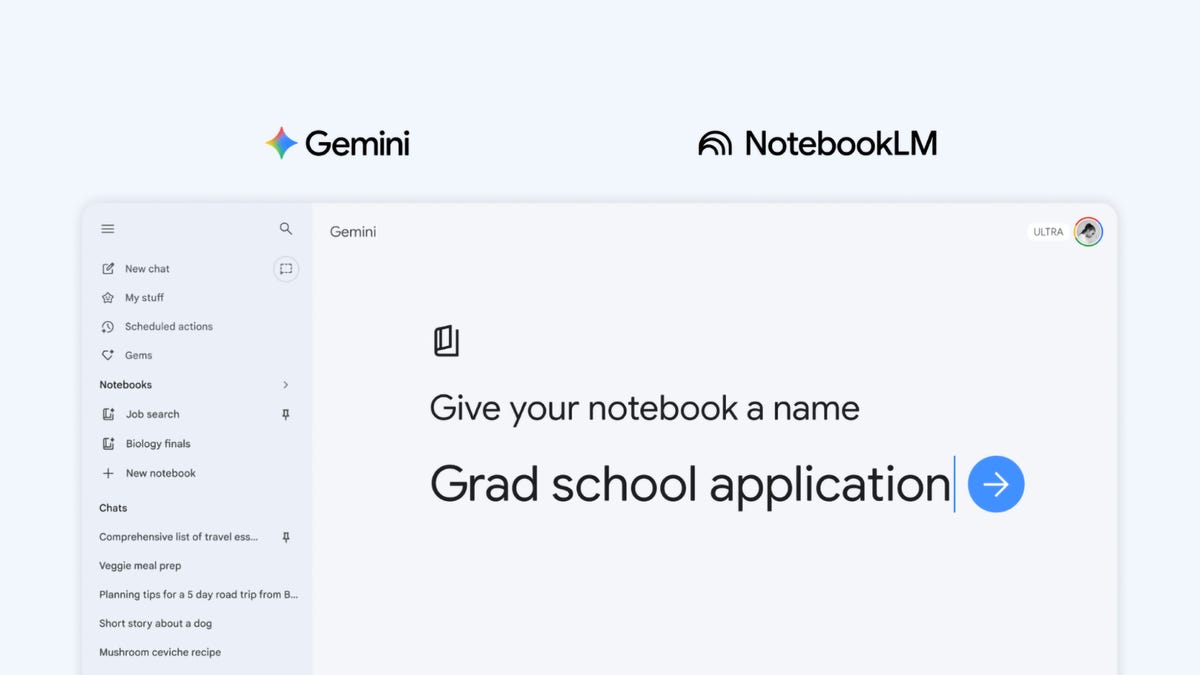
Late last year, Google let users import a NotebookLM notebook into Gemini, treating the notebook as a personal knowledge base. The latest rollout goes further by allowing notebooks to be created directly within Gemini’s interface. A new “Notebooks” section appears in the side menu, where users can start a fresh notebook or open one they’ve previously built. Anything added to the notebook—text snippets, files, previous conversation excerpts—immediately becomes available to Gemini for context, eliminating the need to repeatedly feed the same details.
The two tools now stay in sync: edits made in Gemini appear instantly in NotebookLM and vice versa. This bi‑directional flow opens up new output options. For example, after gathering research in a Gemini notebook, a user can switch to NotebookLM and generate a video overview, an infographic, or other formatted content without leaving the shared data set. The seamless handoff lets each platform play to its strengths while relying on a single, unified database.
Google is initially releasing the notebooks feature to subscribers on its AI Ultra, Pro and Plus plans for the web. Mobile rollout, broader European country coverage, and access for free‑tier users are slated for the weeks ahead. The company says the addition is designed to help students study, professionals prepare for meetings, and creators spark new ideas, emphasizing the flexibility of a personal, self‑contained knowledge hub.
Industry observers note that the move underscores Google’s strategy to differentiate its AI offerings through tighter integration of its own ecosystem. By keeping user data inside Google’s tools, the company sidesteps privacy concerns tied to open‑web searches while still delivering powerful, context‑aware assistance. The notebooks feature could also serve as a template for future AI products that blend conversational agents with domain‑specific knowledge bases.
Early users have praised the ability to keep all relevant material in one place, saying it reduces friction and improves the relevance of Gemini’s replies. As the feature rolls out more widely, Google will likely gather feedback to refine the sync experience and expand the range of output formats available in NotebookLM.
Overall, the notebook integration marks a significant step toward making Gemini a more versatile, knowledge‑centric assistant, positioning Google’s AI suite as a go‑to solution for both everyday tasks and more specialized research needs.