Anthropic Unveils Claude Cowork: Local‑Folder AI Assistant Redefines Desktop Productivity
Key Points
- Anthropic released Claude Cowork as a research preview for Claude Max users on macOS.
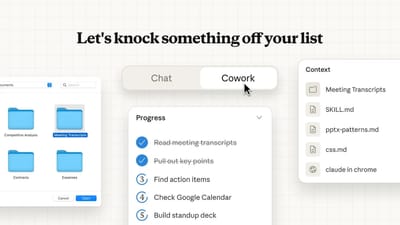
- The feature gives Claude AI direct access to designated local folders for reading, editing, and creating files.
- Users assign tasks such as sorting files, summarizing notes, drafting documents, or making presentations.
- Claude operates under user supervision, offering approval prompts before major changes.
- The local‑first approach shifts AI assistance from cloud‑centric models to on‑device processing.
- Anthropic warns of risks like unintended file edits and prompt injections, providing clear safety labels.
- Claude Cowork aims to make advanced AI automation accessible to non‑technical users.
Anthropic has introduced Claude Cowork, a new feature that gives its Claude AI direct access to local folders on macOS. Available as a research preview for Claude Max users, the tool lets the AI read, edit, and create files, handling tasks such as sorting documents, summarizing notes, drafting reports, and preparing presentations. The system places the user in a supervisory role, offering approval prompts before major changes. By moving AI assistance from the cloud to the local file system, Claude Cowork aims to reshape how people interact with their computers while acknowledging risks like unintended file edits.
Overview
Anthropic has launched Claude Cowork, a feature that integrates its Claude AI directly with a user’s local file system on macOS. The feature is currently offered as a research preview for users of Claude Max. By granting the AI access to designated folders, Claude Cowork enables the assistant to read, edit, and create files on the computer without requiring cloud‑based processing for those actions.
How It Works
Users assign a folder and a specific task to Claude. The AI can then perform a series of instructions, such as sorting files, summarizing collections of notes, drafting documents, or assembling presentations. Throughout the process, Claude operates under the user’s supervision, presenting approval prompts before executing high‑impact changes. This design keeps the user in the role of manager rather than operator, allowing the AI to act semi‑autonomously while the user retains ultimate control.
Potential Impact on Desktop Productivity
The shift from cloud‑centric assistants to a local‑first model could change the rhythm of work. By treating folders as an interface rather than merely containers, Claude Cowork encourages users to describe goals in plain language and let the AI handle the mechanical steps. This could streamline workflows that involve large volumes of files, such as turning a cluttered desktop into a draft blog post or converting a batch of PDFs into searchable summaries. The approach may also inspire a new class of AI assistants that prioritize privacy and local processing, as no data is shared beyond the explicitly granted folders.
Risks and Safeguards
Anthropic emphasizes the risks associated with granting an AI the ability to edit or delete files. The company highlights potential issues like prompt injections and unintended behavior, and it includes clear warning labels. By requiring user approval for significant actions and limiting the AI’s activity to explicitly authorized folders, Claude Cowork attempts to mitigate these concerns while maintaining transparency about its capabilities.
Looking Ahead
If Claude Cowork proves reliable, it could encourage broader adoption of local‑first AI tools that blend the convenience of automation with the privacy of on‑device processing. The feature represents a step toward making sophisticated AI assistance accessible to users without technical training, turning routine file‑based tasks into opportunities for AI‑driven efficiency.